
This week's speaker was Hilary Calvert. Hilary is the Chairwoman of the Otago Regional Council.
Hilary stressed that the opinions were her own personal view and not necessarily the view of the Otago Regional Council.
Hilary titled her speech “Last one out turn the lights out”.
The reason for the title is that the Government has advised all Local Councils that reform is necessary to reduce costs and timeframes for the citizens they serve.
The Government has invited the Local Councils to provide a framework for how this can be achieved, including amalgamation and/or Unitary Authorities as is the case in Auckland. Interestingly, the Regional Councils were not asked to actively participate in this reform.
In Otago, the response was to create a Mayoral Forum of Local Mayors and the ORC Chair. Surveys were circulated to identify areas of concern.
Three themes emerged.
- The importance of Local Voices, particularly the rural/urban divide.
The consensus was to provide a Regional Unitary Authority which would allow for representation from all areas within the geographical area. This would also allow for a stronger single voice when dealing with Central Government.
- Transparency and Accountability was identified as another issue.
Ratepayers want to know in more detail exactly what the Councils are doing and who is responsible for work not completed, not completed on time or on budget and projects or infrastructure that fail.
Previously, the Local Council and the ORC may have had quite disparate views or engineering solutions for the same problem within the same geographical area. These views may also have been influenced by local Iwi. With a single Regional Unitary Authority these views could be aligned.
Substantial funding is generated by Port Otago. The administration of this asset by a Regional Unitary Authority will allow for this funding being used the benefit the whole region.
- Rates and Efficiency was the last area of concern identified.
A Regional Unitary Authority would allow for a simpler governance structure, less duplication and a better use of public money. More services for the same cost.
Hilary believed that when establishing the proposed Regional Unitary Authority (RUA) boundaries, they should reflect the major river catchments. For example, the Clutha should have the same RUA from source to sea, thus avoiding duplication of decision making.
In summary, Hilary believed that Regional Unitary Authorities based on major river catchment areas was the most logical move forward to achieve the Central Governments objectives.
Her closing comment was. “Perhaps the future is not really about the last person turning the lights out. Perhaps it is about turning on a brighter future.”
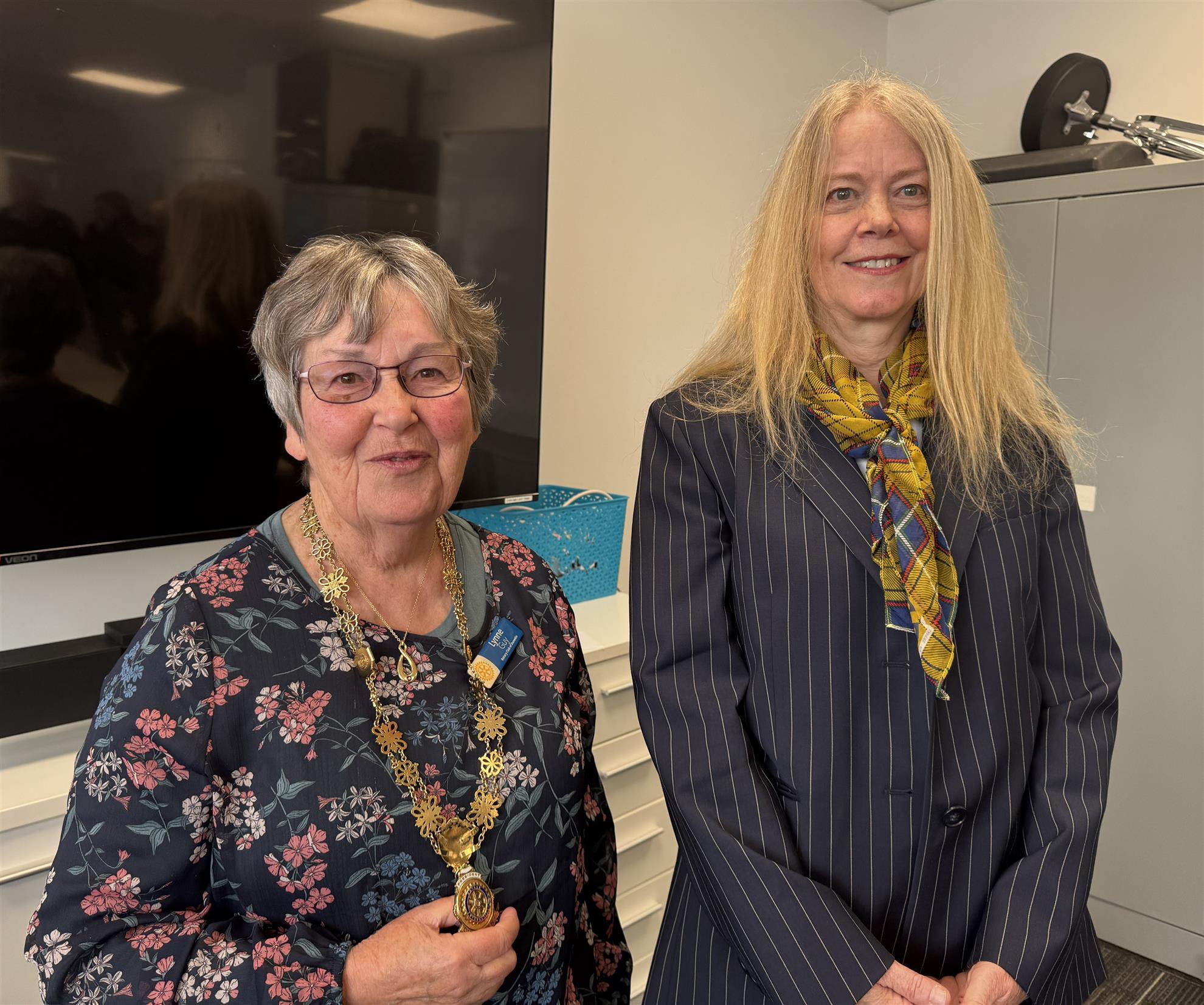
Hilary Calvert pictured following her presentation next to President Lynne Guy . Note that Hilary is wearing a scarf made using the Otago District Tartan design.