
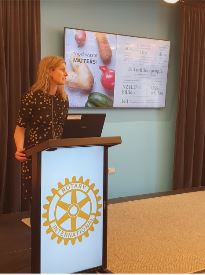
 Last week’s speaker was Associate Professor Miranda Mirosa. Miranda is a Consumer Food Scientist with a background in agri-food marketing and consumer behaviour. She is the Director of the University of Otago Food Waste Innovation Research which measures food waste, develops reduction strategies, applies innovative technology, and works to modify producer and consumer behaviour.
She showed that 40% of all food produced is wasted between the producer and the consumer, landfill food waste produces 10% of all global emissions and at least 4% of NZ emissions, reducing food waste is the third best action to slow climate change and 815 million people in the world face food insecurity.
She also showed that in food production, there was unavoidable food waste where the food is fit only for animal feed or ploughing it back into the ground.
There was also avoidable food waste. This is where perfectly good food that would potentially be thrown out because its selling potential is limited due to it being too small, too big, strangely shaped or doesn’t look perfect or other reasons, is used for human consumption. This type of food should be kept and provided to people who need it most.
Miranda told us about various initiatives to help reduce food waste. Miranda co-chairs a collaborative group of food waste ‘champions’ called NZ Food Waste Champions 12.3. The 12.3 refers to UN Sustainability goal 12.3 to half global food waste by 2030. To help realise this goal in New Zealand, the group with the support of the Ministry for the Environment, and five initial businesses, will be launching a voluntary agreement called Kai Commitment in November this year. This initiative aims to bring into action best practice food waste prevention and reduction strategies across the NZ food business sector.
Another of the NZ Food Waste Champion members is Deborah Manning founder of Kiwi Harvest. Miranda told us that Deborah has also established a nationwide group called New Zealand Food Network. This organisation works at scale to help prevent good food from going to landfill and redirects it to communities who need it most. They collect quality surplus and donated bulk food from producers, growers and wholesalers around the country, and distribute it to food rescue organisations, iwi and charities across New Zealand. It is highly organised and the whole food recycling business has come a long way from the days when people would be going through skips at supermarkets to rescue perfectly edible food that was dumped because it was close to the “best before” date or was yesterday’s bread or whatever. An interesting discussion on people’s perceptions of food quality and best before dates followed. Miranda encouraged us all to make use of ‘wonky veges’ and keep focused on the economic and environmental benefits reducing food waste across the supply chain can bring.