
Moa Footprints
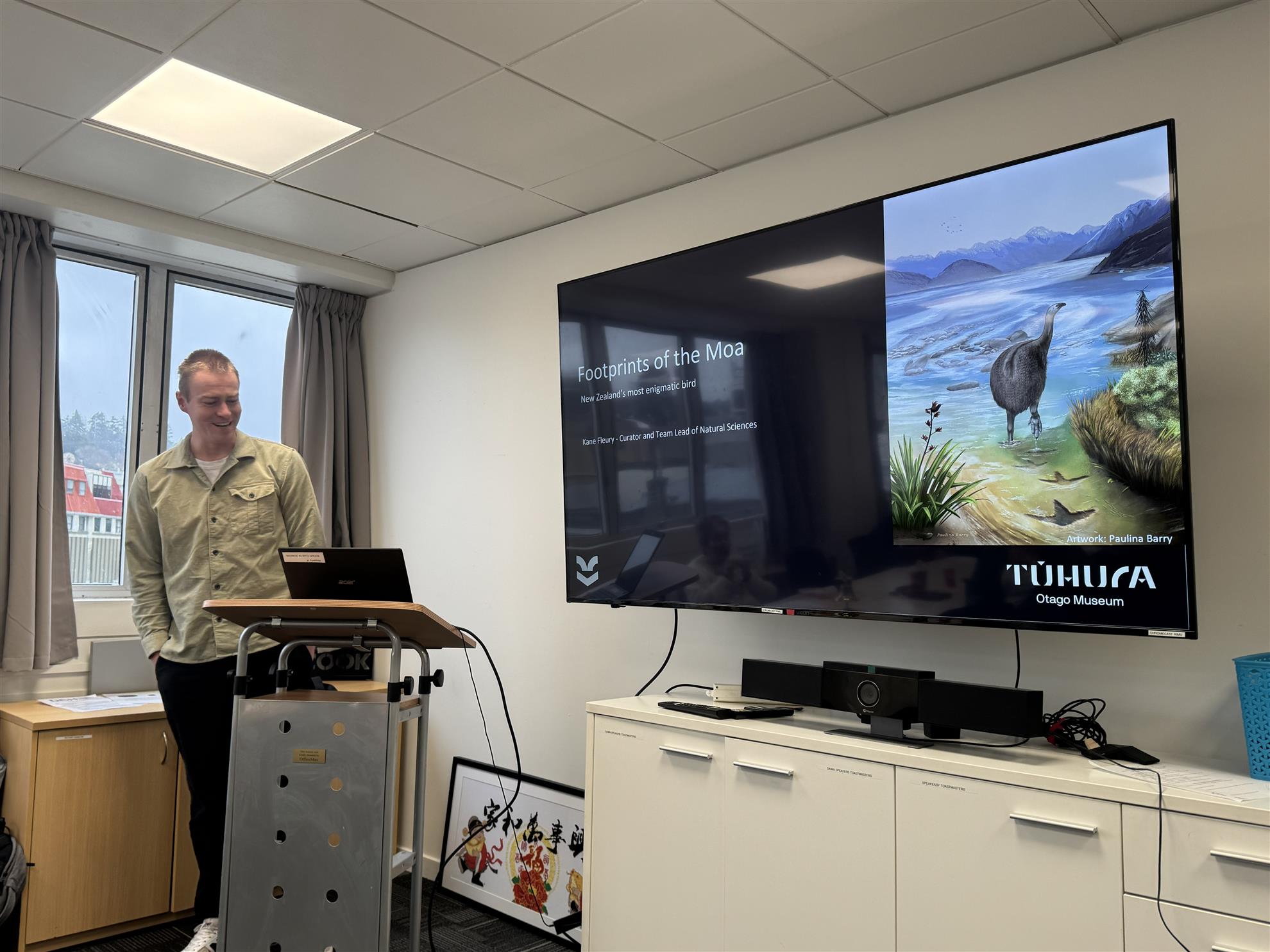
Kane Fleury is the curator and team leader of Natural Sciences at Tuhura Otago Museum.
Following the 2019 discovery of a trackway of seven moa footprints on the Kyeburn riverbank in 2019, Kane was one of the first people on the scene. Kane showed us a video of him diving into the river to inspect the 1.8m deep, remarkable fossil footprint discovery. Since 2019, Kane has lead the research into these moa footprint fossils and finding answers to some key questions - How old were these moa footprints? What type of moa made them? How big was this moa? What speed was it travelling at when it made the tracks?
Kane commenced his enthusiastic and entertaining address telling us about the cultural importance of Moa to pre-European Maori, and how 19th Century European settlers and natural history investigators, such as Walter Mantell, met curiosity when finding an abundance of bones, sometimes enough to make fertilizer with. They wanted to know 'what these birds' were. Walter sent Moa bones to his father Gideon, was the curator of the London Natural History Museum. At this time, dinosaur bones were also being discovered, named and classified. Gideon Mantell is credited with discovering four of the five genera of dinosaurs then known, and for coining the terms 'terrible lizards' and ‘terrible birds’ -after which moas were formally named Dinornithformes. At this time, moa bones were collected alongside dinosaur bones and considered essential for Natural History museum's collections around the world.
Kane told us that there were nine species of moa, with seven of those nine evolving in the South Island, and two in the North Island. Kane went on to discuss the origins of moa, with current research indicating that they may have evolved from Central America's Great Tinamou bird (mou meaning jaw). From the study of genetic materials quite detailed and complex family trees for the 9 moa species have been generated.
The study of the fossil footprints found in 2019 at Kyeburn are a great example of the application science of 'Ichnology' or the study of traces of fossils that preserve evidence of the behaviour of once living creatures, such as tracks, trails and ecosystems as opposed to physical remains such as bones, skin, feathers and fur. Kane told us that there are seventeen sites in NZ where moa footprints have been found.
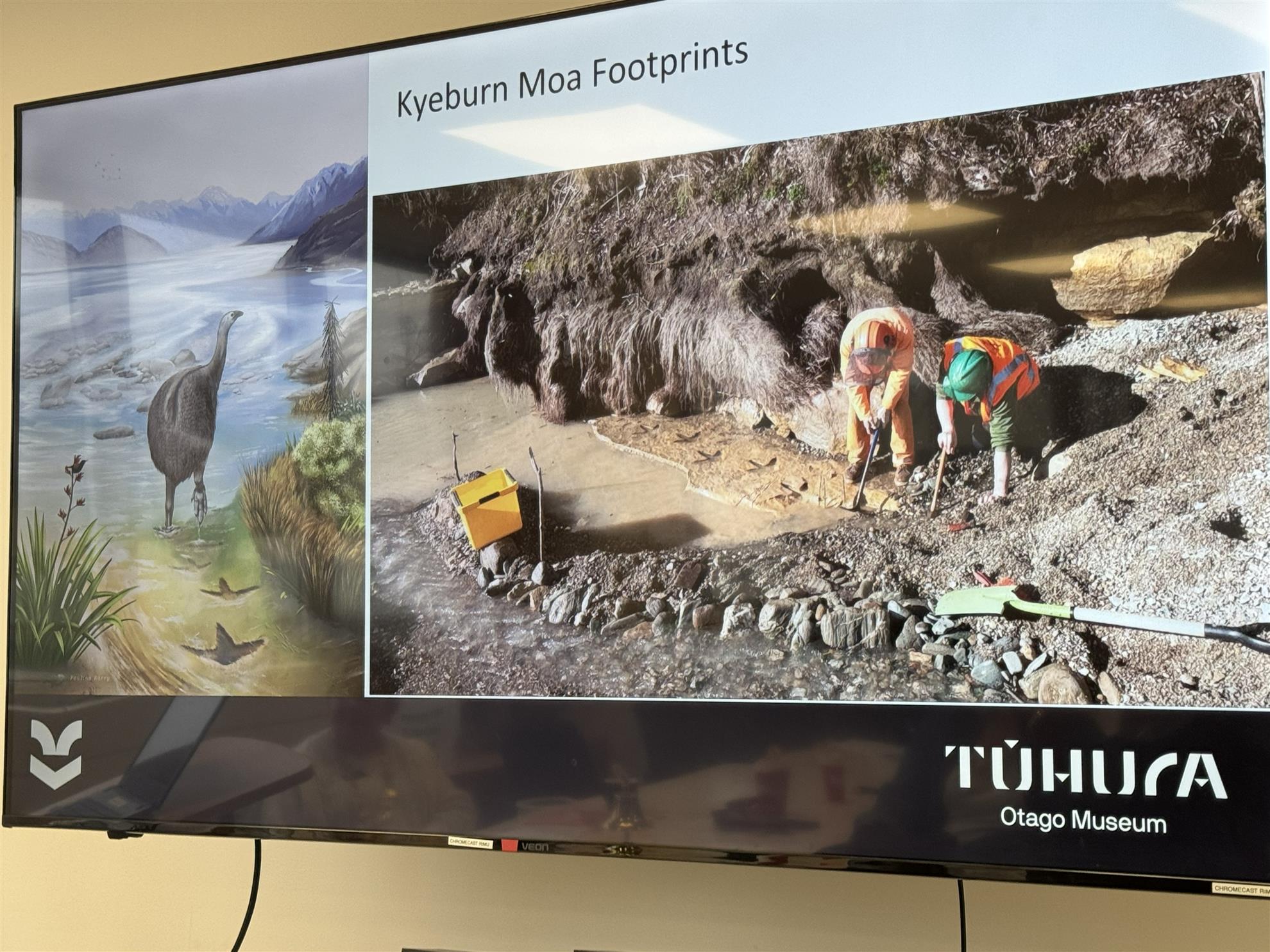
Following the March 2019 Kyeburn moa footprint discovery site, Kane and his team from Otago Museum quickly arranged for the river to be temporarily diverted and for the rock material with the footprints to be uplifted and moved to the museum for preservation, study and public display. Kane explained to us that the question on his and everyone's mind was 'how old are these fossils?'. To answer this question, the Australian Nuclear Science and Technology unit helped by providing a technique known called 'cosmogenic nuclide dating'. Using this state of the art dating technique, Kane and his team could establish the age of the moa footprints to be 3.6 million years old.
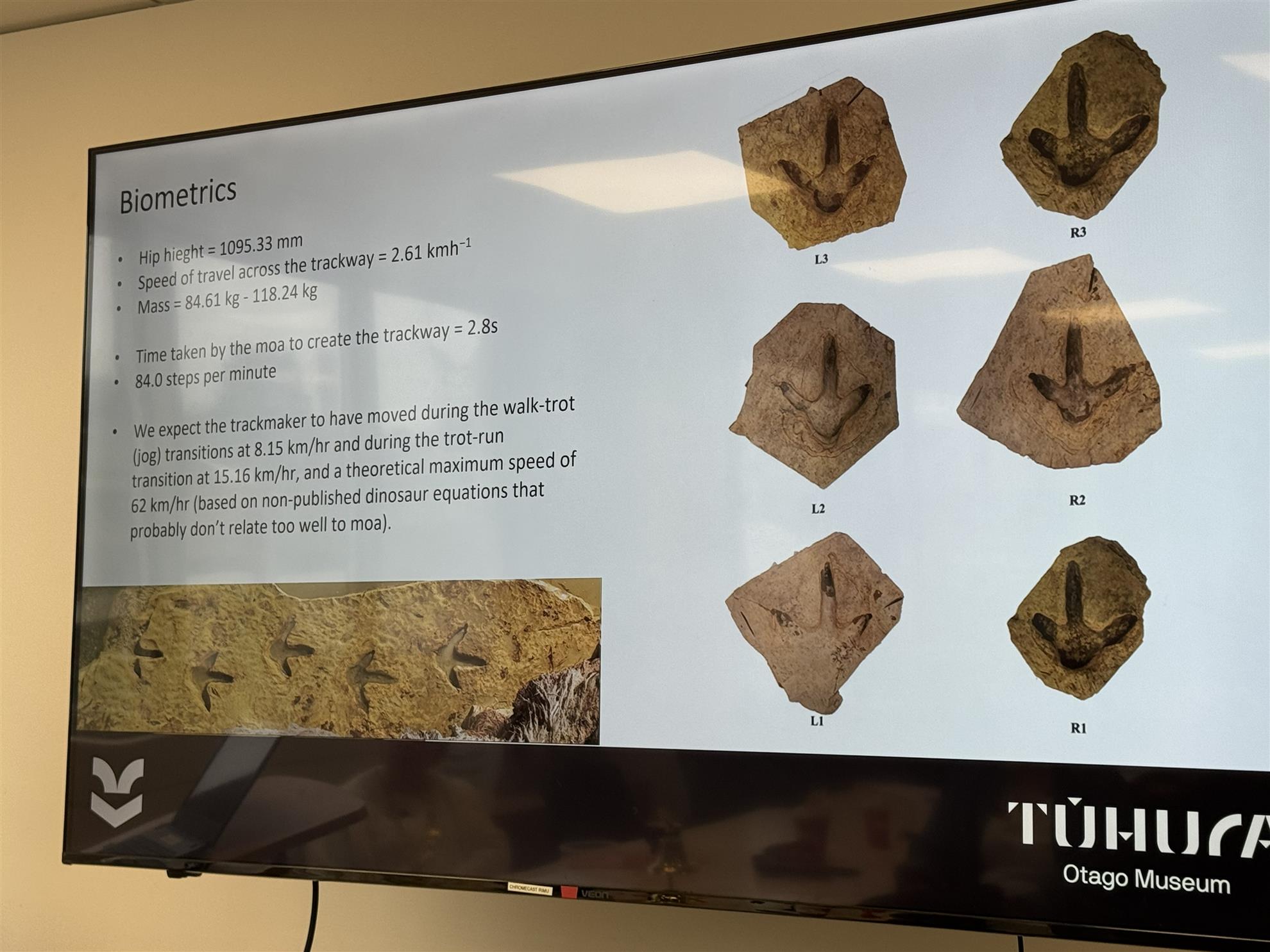
The measurement of the moa footprint tracks themselves revealed essential biometric data that has helped answer Kane's other research questions, how big were these moa , what did they weigh and how fast were they travelling? The results showed that the moa who made the tracks measured 1095mm at the hip, weighed 85kg -118kg and was walking (slowly) at 2.6 kph, or 85 steps per minute! The researchers have identified this moa as being from the Emeus family and a relative of the 'heavy footed moa'.
Another remarkable discovery from the Kyeburn footprint fossils was one larger but fainter footprint, The study of this fossil footprint has revealed it was likely to be that of a female giant moa (Dinornis spp) weighing in at 158Kg!
Kane's knowledge and insights from his scientific study of moa, and our local natural history in general, was enthusiastically shared with us. Some good discussion on how moa had no predators other than the Haast Eagle, a slow reproduction rate, slow to mature and very very fragile eggs (the thinnest eggs of any bird) meant that the species could not stand up to hunting and led to their extinction. Kane warned that if you think you see some fresh moa prints in the sand or clay, they very well might be emu's. Fossils like the Kyeburn moa footprints are a remarkable find and the careful study of them helping us to get a better understanding of this land we live on, and the moa, one of New Zealand's cultural icons.
Thank you Kane!