
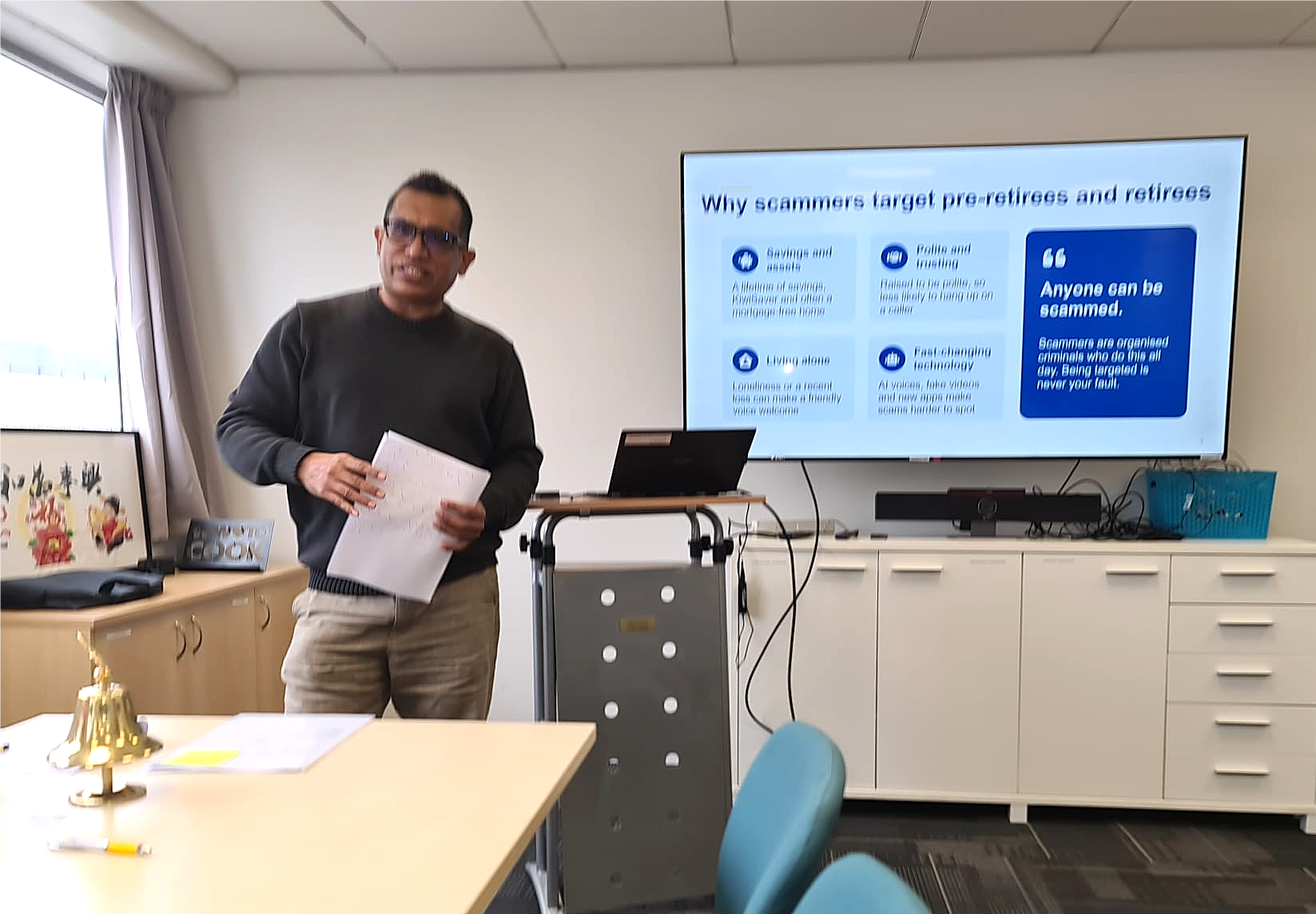
Dr Muhammad Cheema is a Senior Lecturer in Finance and Director of the BNZ Bloomberg Markets Lab at the University of Otago. His teaching and research interests focus on investments, behavioural finance, machine learning, and energy finance.
Last Thursday he gave us a talk about scamming and how to protect ourselves. As he mentioned at the very beginning the purpose of the seminar was not to present the different ways of scam but also how to protect and build the awareness of how to protect us and our loved ones.
Based on the MBIE data from 2025 New Zealanders lost over $265m to scams and fraud in one year. Same data showed that over 75% of adults faces any forms of financial scam and over 25% are in some ways a victim of it within last 12 months. Scammers target everyone but the biggest group are the people pre-retirement or retirees as they perceive elderly people as those who have savings and assets, raised to be polite and are trusting more, loneliness and new technologies have opened more sophisticated ways of scamming.
How the scammers work:
* they pretend to be someone we trust - bank representative, insurance agent, police
* they always rush and put a time pressure on you
* they will play and stir on strong feelings like fear, excitement, love or guilt
* ask to keep all in secret and not share this with others
* want immediate or very unusual payments
If you feel or encounter any of this during any call or email:
STOP - don't make any decisions or actions in rush or based on the emotions?
THINK - is this real, can this institution call with the request to pay or give someone my access details? Is the person that is calling really my family member/relative?
ACT - disconnect and call the organisation from which you get a disturbing call and ask, call to the relatives and ask.
Dr Cheema also briefly showed the common scams in New Zealand and provided common examples and how to protect ourself.
* fake bank or insurance calls
* fake texts and emails from various institutions
* fake IRD or Police calls
* "Hi mum / granny, I need help" calls
* Computer / subscription "support" calls
* romance scams
* crypto and investment scams
* doorsrtep and charity scams
He provided the information who to call if we became a witness or victim of the scam:
* Police - 105
* Your Bank
* Netsafe - 0508 638 723
* National Cyber Security Centre - 0800 114 115
* Report Scam Text messages - forward them to 7726
* IDCARE (Identity theft) - 0800 121 068
Six thigs to remember:
1) unexpected, urgent or too good to be true - STOP
2) Hang up and call back on a number you trust
3) Never share codes, PINs, passwords or logins
4) Never send money to someone you haven't met
5) Talk to someone before you pay
6) If it happens call your bank at once
How scammers work and what tools they are using:
Thanks to current technology they can impersonate our relatives using some of the photos or recordings we are sharing online on social media to create very sophisticated fake calls using our modulated voice or recreated by AI.
They work 24hours a day to find more sophisticated ways to cheat us.
Thanks to social media they can gather more information about us and use it against us.
Dr Cheema also shared his presentation with the members of the club to share across to build awareness and give more information to all (sent to members via email this week or click here).
Dr Cheema also invited members to contact him by email if they have any questions.
His email address is Muhammad Cheema: muhammad.cheema@otago.ac.nz