Lunch arrangements:
Tea and coffee available and it's a BYO lunch. Food outlets nearby range from Sushi to Subway, Kebabs to Night & Day, and local cafes like Bru located on Moray Place. Alternatively, just make yourself a cuppa!
Members are encouraged to attend Thursday lunch meetings whenever they can. Guests are also welcome. Meetings are an opportunity for fellowship, to hear interesting speakers and to catch up with our Club activities. If you are unable to join our lunch meetings in person, we can still provide a Zoom option.
Welcome Ben!
President Lynne had the privilege of inducting a new member at our meeting last week, Ben Merhtens. Ben was introduced by Brian Daniels and Brian will be Ben's mentor as he settles into the club. Ben is following in his grandfather Geoff's and father Dave's tradition of belonging to Rotary, this makes Ben a ‘third generation’ Rotarian. Ben and his partner Emily have two young daughters and moved two years ago back to Dunedin following time abroad. Ben is an electrical engineer who likes understanding how things work, problem solving as well as business development and entrepreneurship. Ben and Emily have recently established a business called Riverline specializing in electrical switch board review and modernisation. Click here to learn more about Ben! We look forward to getting to know Ben and warmly welcome him to Rotary Dunedin.
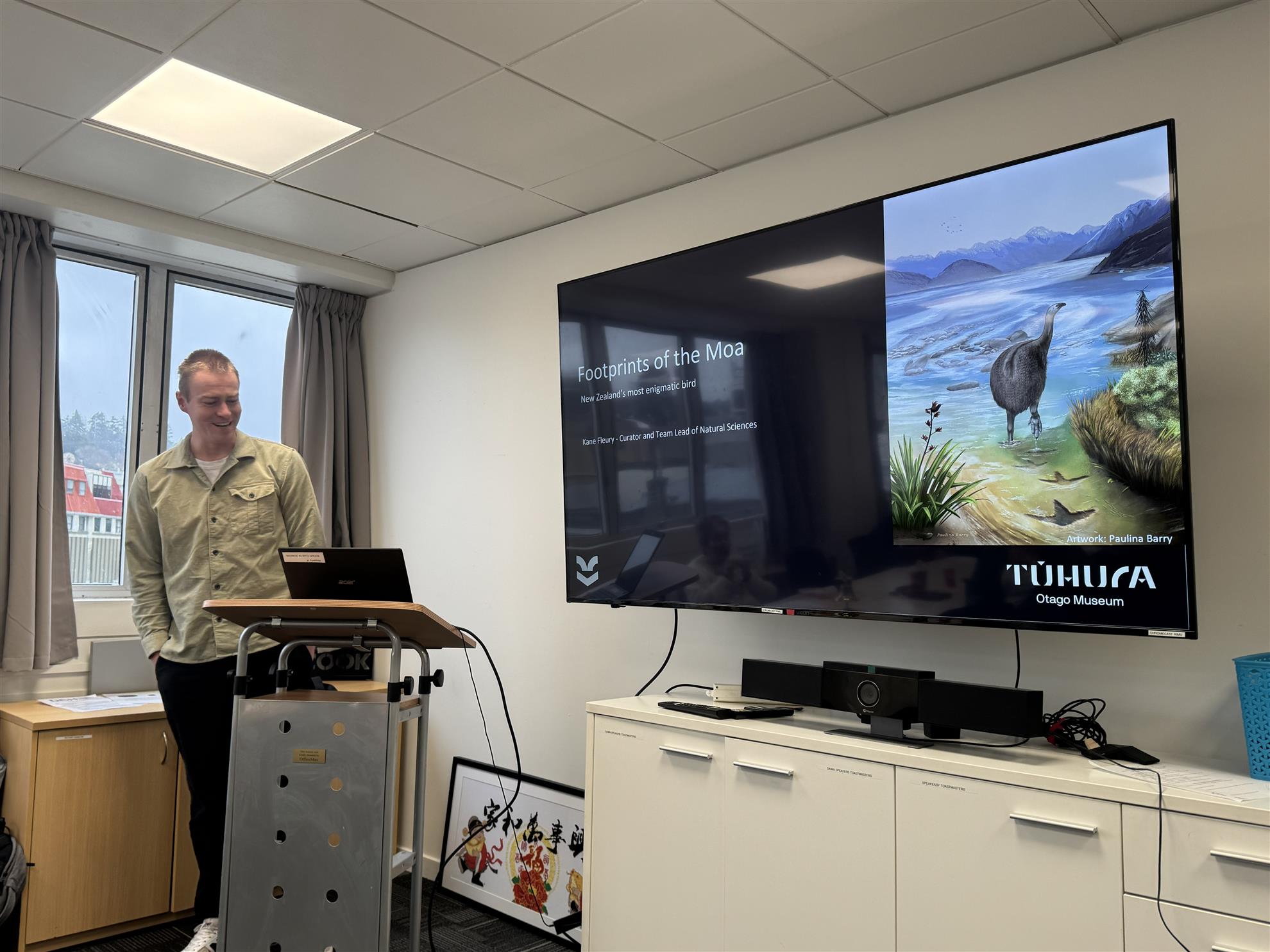
Kane Fleury is the curator and team leader of Natural Sciences at Tuhura Otago Museum.
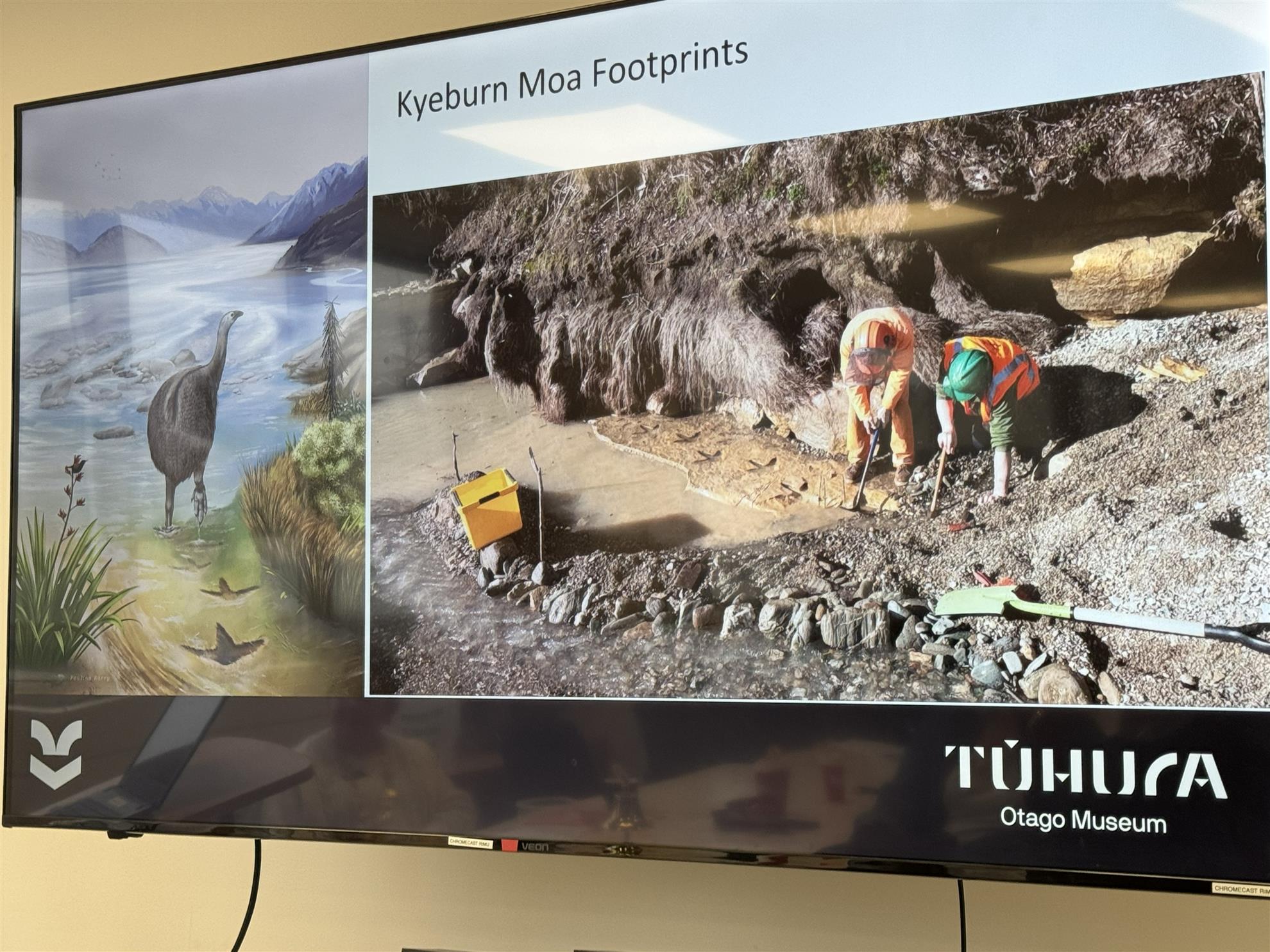
Following the 2019 discovery of a trackway of seven moa footprints on the Kyeburn riverbank in 2019, Kane was one of the first people on the scene. Kane showed us a video of him diving into the river to inspect the 1.8m deep, remarkable fossil footprint discovery. Since 2019, Kane has lead the research into these moa footprint fossils and finding answers to some key questions - How old were these moa footprints? What type of moa made them? How big was this moa? What speed was it travelling at when it made the tracks?
Kane commenced his enthusiastic and entertaining address telling us about the cultural importance of Moa to pre-European Maori, and how 19th Century European settlers and natural history investigators, such as Walter Mantell, met curiosity when finding an abundance of bones, sometimes enough to make fertilizer with. They wanted to know 'what these birds' were. Walter sent Moa bones to his father Gideon, was the curator of the London Natural History Museum. At this time, dinosaur bones were also being discovered, named and classified. Gideon Mantell is credited with discovering four of the five genera of dinosaurs then known, and for coining the terms 'terrible lizards' and ‘terrible birds’ -after which moas were formally named Dinornithformes. At this time, moa bones were collected alongside dinosaur bones and considered essential for Natural History museum's collections around the world.
Kane told us that there were nine species of moa, with seven of those nine evolving in the South Island, and two in the North Island. Kane went on to discuss the origins of moa, with current research indicating that they may have evolved from Central America's Great Tinamou bird (mou meaning jaw). From the study of genetic materials quite detailed and complex family trees for the 9 moa species have been generated.
The study of the fossil footprints found in 2019 at Kyeburn are a great example of the application science of 'Ichnology' or the study of traces of fossils that preserve evidence of the behaviour of once living creatures, such as tracks, trails and ecosystems as opposed to physical remains such as bones, skin, feathers and fur. Kane told us that there are seventeen sites in NZ where moa footprints have been found.
Following the March 2019 Kyeburn moa footprint discovery site, Kane and his team from Otago Museum quickly arranged for the river to be temporarily diverted and for the rock material with the footprints to be uplifted and moved to the museum for preservation, study and public display. Kane explained to us that the question on his and everyone's mind was 'how old are these fossils?'. To answer this question, the Australian Nuclear Science and Technology unit helped by providing a technique known called 'cosmogenic nuclide dating'. Using this state of the art dating technique, Kane and his team could establish the age of the moa footprints to be 3.6 million years old.
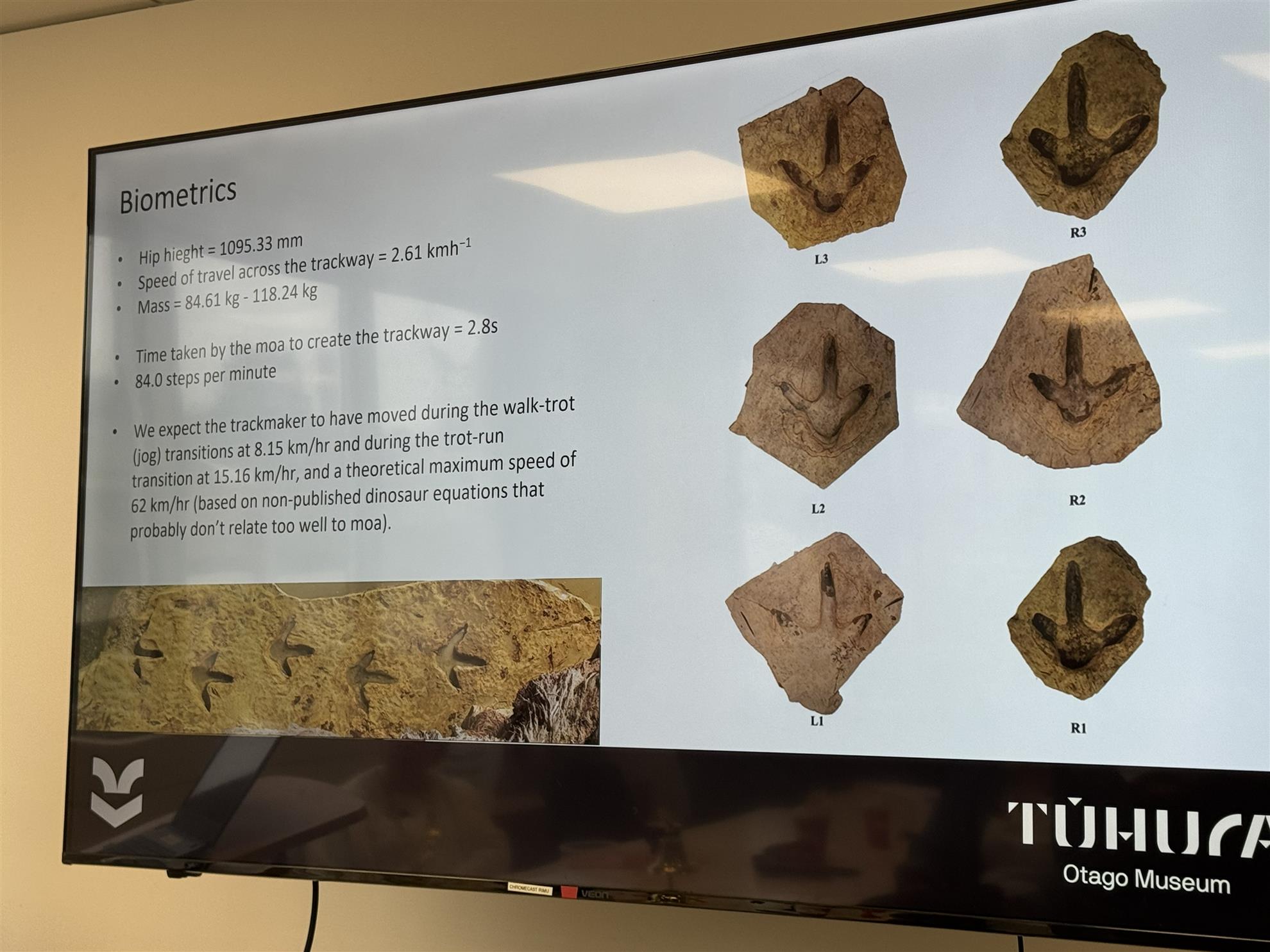
The measurement of the moa footprint tracks themselves revealed essential biometric data that has helped answer Kane's other research questions, how big were these moa , what did they weigh and how fast were they travelling? The results showed that the moa who made the tracks measured 1095mm at the hip, weighed 85kg -118kg and was walking (slowly) at 2.6 kph, or 85 steps per minute! The researchers have identified this moa as being from the Emeus family and a relative of the 'heavy footed moa'.
Another remarkable discovery from the Kyeburn footprint fossils was one larger but fainter footprint, The study of this fossil footprint has revealed it was likely to be that of a female giant moa (Dinornis spp) weighing in at 158Kg!
Kane's knowledge and insights from his scientific study of moa, and our local natural history in general, was enthusiastically shared with us. Some good discussion on how moa had no predators other than the Haast Eagle, a slow reproduction rate, slow to mature and very very fragile eggs (the thinnest eggs of any bird) meant that the species could not stand up to hunting and led to their extinction. Kane warned that if you think you see some fresh moa prints in the sand or clay, they very well might be emu's. Fossils like the Kyeburn moa footprints are a remarkable find and the careful study of them helping us to get a better understanding of this land we live on, and the moa, one of New Zealand's cultural icons.
Thank you Kane!
Upcoming Events
Rotary Clubs of Dunedin Charity Lunch
!!!Date Change!!!
Now scheduled for 25 September at the Glenroy
Rotary Clubs of Dunedin Fundraising Lunch with guest speaker The Right Honorable Christopher Luxon, Prime Minister of New Zealand on the priorities shaping our future.
Funds raised go to two Rotary community projects -
The Rotary Park Ugrade project and the new Dunedin Hospital Outpatient Building, supporting both Children's play spaces and funding a virtual reality equipment that helps children prepare for MRI scans, reducing fear and the need for sedation.
Please contact Greg Angell if you would like to buy a ticket and attend but be quick, Greg informs us that the event is looking like a sell out.
RSVP Now for the Rotary Four-Way Secondary School's Speech Competition-
Regional final 15 Sep 5.30pm
The Rotary Four-Way Secondary School's Speech Competition has been an annual event in the Rotary calendar for some years now. It started at the District Conference in Invercargill in 2003 by the then DG Don Irvine and has been held ever since. The competition is for year 12 and 13 secondary school students.
2026 Area finalists from Southland, Dunedin and Central Otago have now been selected and will be competing in the regional final contest on 15 September.
The event is hosted by the Dunedin Central Rotary Club. 📍 The Dunedin Club, 33 Melville Street 🕠 5:30pm arrival for a 6:00pm start
Donations to: RNZWCS Limited Westpac Acc. 03 1702 0192208 01 placing 303N in the ref. field Swift Code: WPACNZ2WXXX Rotary New Zealand World Community Service www.rnzwcs.org Registered Charity CC2686
Please consider becoming involved with this campaign
Say No to Domestic Violence and Yes to Respectful Relationships Campaign - Will our club get involved?
We have been invited to participate in a new campaign that has already been established in Australia and will be launched in New Zealand soon. The Rotary Oceania organisers are seeking expressions of interest from all NZ clubs.
The campaign is considered to be a big step forward for Rotary across the country because Rotary has partnered up with the Police, Social Service agencies and Relevant Support Networks. This campaign is a huge opportunity to lift the lid of Rotary's image, help address the current stats of Family and Domestic Violence as well as generate a better interest from the community to be part of Rotary.
In Australia some clubs have increased membership from 30 to 99 members due to this campaign capturing the community's interest.
To commit to the project as a club member, we would all be required to purchase a campaign t shirt ($40-50 tbc) and wear the t shirt on Fridays. We would also be asked to wear the t shirt and particpate in an organised street march later in the year.
As a member of Dunedin Rotary, you will soon receive an email from your committee director asking for your feedback on participating in this campaign.
The five week roster is the most accurate and members are urged to check the Duty Roster webpage regularly.
Instructions for setting up and tidying the room
The duty team are responsible for setting up the room which involves placement of the tables & chairs (in sets of six chairs per table, tables placed lengthwise down each side of the room), please ensure that you arrive in time to assist with this. We also have to put the tables and chairs back after the meeting, please ask members to help the duty team if they can. Place used cups and spoons in the white bin on the trolley to take to the dishwasher. Duty officers are asked to load the dishwasher but not to turn it on.
SPEAKER HOSTS please remember to send a summary of the Speakers presentation complete with photo to Fiona fiona.robin@outlook.com
The weekly speakers list has been updated through to 17 Dec 2026. Click on the ‘entire list’ link to view.
A working bee was held last Tuesday to prepare the holes for the next 145 trees scheduled to be planted this Wednesday. Thank you to everyone who volunteered and helped prepare the ground for the next planting session, which is on:
Wed 2nd Sep, 1 pm.
We're looking forward to working with a group of Year 13 Kaikorai Valley College Outdoor Activity students who will be planting out a new area located above the dog park and moving some mulch.
Rotary volunteers are needed to help supervise the students.
Volunteering Opportunity In October
Volunteers are sought to give two hours of their time for the Pink Ribbon Street Appeal on Friday 16 and Saturday 17 October.
Yesterday I headed off to Bhutan with Jesse Mulligan from RNZ This segment on Afternoons was asking for kiwis travel stories so I sent in an email proposing Bhutan as a destination travelled to by that blind woman. I always love the opportunity to share from my sensory diary which is what I did. If you’d like to listen here’s the link: https://www.rnz.co.nz/national/programmes/afternoons/audio/2019049222/heading-off-to-bhutan Happy travels!